These cookies are used to provide you with a more personalized experience on our website and to remember
choices you make when you use our website.
For example, we may use functionality cookies to enable commenting functionality.
These cookies are used to collect information to analyze the traffic to our website and how visitors are
using our website.
For example, these cookies may track things such as how long you spend on the website or the pages you visit
which helps us to understand how we can improve our website site for you.
The information collected through these statistics and performance cookies do not identify any individual
visitor.
Read more about exact cookies we use in our Privacy Policy
Mañanita BCP
Yerba Mate Review
7 minutes to read
Share this article
Copy link to clipboard
If you make a purchase through links in this article, I get a small commission at no cost to you. Learn more
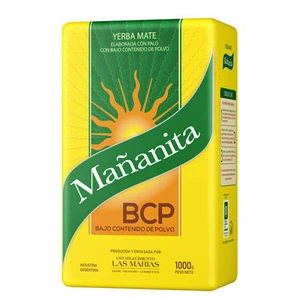
With this yerba mate, Las Marías aimed to create a low effort, nice and light yerba mate for those who are just starting out their yerba mate journey. In my opinion, Mañanita BCP is their answer to the raising popularity of Playadito, which is widely considered to be the go-to yerba mate for beginners. Yellow bag, similarly diminutive name, enveloping sweet aroma — all indicates to me that Las Marías has looked into the Cooperativa Liebig’s playbook. But instead of copying their formula, Mañanita went their own way, and created yerba mate that clearly tastes and feels like a Las Marías’ twist on Playadito, as if they mixed Taragüi Con Palo and Playadito Con Palo together, creating quite unique and approachable flavor profile. And I suspect not only novice materos might enjoy this yerba mate.
Use code MateExperience10 for 10% off the whole order!
First look
Nose
The aroma of Mañanita BCP is very pleasant and fragrant.
It smells extremely sweet, and almost candy-like.
The nose also has some tartness and fruitiness to it, not even dry fruitiness like in most aged Argentine yerbas, but a more fresh fruity aroma, like a freshly cut apple or plum.
I also get earthy and woodsy notes, some hay, and sweet pipe tobacco notes.
There is no smokiness to it that I can detect, and overall Mañanita BCP has a very welcoming and quite rich appeasing aroma to it.
Cut
BCP in the name of this yerba mate stands for bajo contenido de polvo, meaning lower powder content.
And looking at the cut of Mañanita BCP it is definitely the case — there’s almost no visible dust in this yerba mate.
It is still present though, as you can notice that the leaves and stems are slightly covered in dust.
Other than the lower powder content, Mañanita BCP is a fairly typical con palo yerba mate, where ratio of stems to leaves is in favor to the latter.
Both leaves and stems are ground moderately — not too coarse and not too fine — and are pretty even in size.
The color of the cut is quite saturated for aged Argentine yerba mate, but is not as even as the cut, with frequent inclusions of both paler and lighter leaves, as well as darker and toasted brownish, which means that this yerba mate was quickly seared with fire before being properly dried during its production, which is a pretty standard process for Argentine yerba mate.
Preparation
With this Mañanita being a BCP and con palo yerba mate, there is absolutely no chance you will clog your bombilla during traditional preparation.
My only concern before I tried this yerba mate was that the lower powder content will make it harder to build and maintain the mountain of yerba.
On one hand mountain is not necessary for Argentine yerbas, but I still like to create one during my drinking session because it yields in a more balanced mate, and luckily for me, my fears proved unfounded — Mañanita BCP formed a nice stable mountain in the gourd.
When it comes to temperature of water, this mate proved to be quite forgiving and non-demanding.
I enjoyed drinking Mañanita BCP at the temperatures between
60° Cand75° C/140° Fand165° F, although there are some taste nuances that come out only at hotter and colder water in that range, but more on that later.
Water that is hotter than
80° C/175° Fhowever in my experience made this mate too dull and flavorless, so my advice is to not overheat your water for Mañanita BCP.
It’s not going to be overly bitter or strong, but you’ll lose too much flavor and durability to make it worthwhile.
When I looked at the yellow bag of Mañanita BCP, I thought that this yerba mate would be a Las Marías’ answer to a popularity of Playadito Con Palo, which quickly became Argentina’s favorite yerba over the last few years due to its sweet and pleasant taste profile that is approachable and likeable right off the bat to the novices, and still satisfying as a daily no-brainer mate for seasoned materos.
And the sweet candy-like nose of this yerba mate suggested that it will indeed be a competitor to Cooperativa Liebig yerbas.
However, the first few sips of Mañanita BCP turned out to be not as straightforward as I thought they would be.
It is sweet, but it’s also pleasantly bitter, more bitter than Playadito Con Palo.
Straight up, I get lots of nutty and chocolate notes — hazelnuts, cocoa, and even coffee.
Because of lower dust content, the flavors are sharp and clean; it is a light-bodied mate, but not watery or tasteless.
At
70° C-75° C/160° F-165° Fit reminds me more of its cousin yerba, Taragüi Con Palo, with its tobacco- and wormwood-like bitterness.
Nutty earthy notes are more pronounced at this temperature, but are balanced nicely with more sweetness than I remember in Taragüi.
At slightly lower temperature, around
60° Cto65° C/140° Fto150° F, more of the sweetness start to come through, as well as some astringency and pleasant fruity-like acidity.
There’s less earthy tobacco notes sensible at this water temperature, while nutty notes are still here.
Overall, it is indeed a sweet and simple yerba mate, just like Playadito, but in its own unique “Las Marías” way, as if they somehow mixed Playadito and Taragüi.
Finish
Despite quite simple yet pleasant flavor profile, the aftertaste of Mañanita BCP is long and lingering.
Nutty and hay notes dominate the finish of this mate, and stay in the mouth for quite a time after swallowing the sip.
That striking bitterness becomes even more pronounced in the aftertaste of Mañanita BCP, and when sipped too fast made me want to chase every couple of sips with water.
In that sense, this mate is not very drinkable, but if you’re not in a rush you can lower your refilling cadence and savor each sip for extended time.
Install our free web app!
It is instant and won't take up space on your device. Keep reading Matexperience anytime, anywhere — even offline.
Durability
As I mentioned earlier, water that is hotter than
80° C/175° Fwill lower the durability of Mañanita BCP and will make it quite short, around 12 refills on average from my experience.
However, don’t expect this mate to be much longer with colder water.
Every time I sipped Mañanita BCP with water in range between
60° Cand75° C/140° Fand165° F, I got consistent 15 refills from this mate, which is right on the edge between what I consider to be short and moderate durability.
Since Mañanita BCP is leaning more into shorter durability with hotter water, I think it is fair to consider it to ultimately be a short mate.
You can create a slight evolution of flavors throughout the duration of drinking of Mañanita BCP by heating your water to
75° C/165° Fand letting it naturally cool down over the whole session, but if you have a good thermos or deliberately re-heat the water to stay at a certain temperature — don’t expect any flavor changes just from the amount of refills, there are no hidden extra flavors to eventually bloom after certain duration like in a more complex yerbas.
When this mate ends, lavado happens quite gradually and even after Mañanita BCP is washed out the residual sweetness allows you to enjoy it for a couple of more refills.
The last thing you want while drinking mate is to constantly re-heat your water or add more ice to it.
No matter if it's hot mate or cold tereré,
use a
vacuum bottle
or a very popular in South America
mate thermos
with spout.
Effect
Mañanita means “a little morning” in Spanish, so of course first things first I had to try this mate in the morning.
During and after drinking through Mañanita BCP, I definitely experienced increased awareness, clarity and focus, but that was provided that I had a good night of sleep beforehand.
This mate didn’t really give that much energy and invigoration, so if you shaved a couple of hours off your night — don’t expect Mañanita BCP to magically bring you back to life.
On the other hand, this neutrality made it pretty safe to sip on this mate in the evening, not so much to unwind and relax at the end of the day, but to give yourself a bit of extra comprehension for a book or a movie.
Overall, Mañanita BCP is a solid all day mate.
* * *
Don't forget to explore the rest of our growing library of 70+ comprehensive, in-depth yerba mate reviews.
What are your thoughts on Mañanita BCP? Comment below!
Join the free email newsletter!
Get access to new content as soon as it is published and receive exclusive offers, deals and discounts on yerba mate and related products! You can unsubscribe anytime.
BCP
Stands for bajo contenido de polvo, or lower powder content in Spanish.
BCP indicates an elaborated yerba mate where most of the dust has been removed from the final cut of the product.
Vast majority, if not every BCP yerba mate is also a con palo.
In Argentina, according to point 2.1.1 of the article 1194 of Argentine Food Code, BCP yerba mate should not contain more than 10% of fractions that passed through № 40 sieve (0.420 mm mesh opening).
Special drinking straw with a filtration system in the lower end of it.
Usually made from metal or hollow-stemmed cane.
Bombilla is used for drinking mate traditionally from a gourd.
With stems in Spanish.
Con palo is a type of yerba mate cut which is characterized by presence of stems, or palos in Spanish.
Usually mate brewed with con paloyerba mate is more light and sweet than mate prepared from sin palo cut.
Very popular in Argentina and Paraguay.
In Argentina, according to point 2.1 of the article 1194 of Argentine Food Code, con paloyerba mate should contain no less than 65% of dried leaves, coarsely ground or pulverized, and no more than 35% of coarsely or finely ground stems and sticks.
A vessel used for drinking mate traditionally.
Usually it is made from a real dried calabash gourd, or calabaza in Spanish, hence the name.
Today the term gourd is used not only to describe a calabash vessel, but any other cup from which mate is being drank (wooden, metal, ceramic, etc.).
Pronounced [MAH-teh].
Traditional South American caffeine-rich infused drink, very popular in Argentina, Paraguay, Uruguay and Southern Brazil (the term chimarrão is used there more often).
It is prepared by steeping dried leaves of yerba mate in the gourd.
Sometimes the gourd itself is referred to as mate.
When mate is prepared traditionally, a mountain of yerba is yerba that is located inside the gourd in form of slope, that is exposed to hot water while drinking.
Proper mountain of yerba will be always half-dry and half-wet, which results in more balanced and long mate.
On the opposite side of mountain is the water hole.
Pronounced [YER-bah MAH-teh] (or [SHER-bah MAH-teh] in Rioplatense Spanish).
Also known as Ilex paraguariensis, a holly plant natively grown in South America, particularly in Northern Argentina, Paraguay and Southern Brazil (the term erva mate is used there more often).
Yerba mate is used to make a beverage known as mate in Spanish, or chimarrão in Portuguese.
Often, the term yerba mate is used to describe not only a plant, but also a final product of grinding, drying and aging the plant.