These cookies are used to provide you with a more personalized experience on our website and to remember
choices you make when you use our website.
For example, we may use functionality cookies to enable commenting functionality.
These cookies are used to collect information to analyze the traffic to our website and how visitors are
using our website.
For example, these cookies may track things such as how long you spend on the website or the pages you visit
which helps us to understand how we can improve our website site for you.
The information collected through these statistics and performance cookies do not identify any individual
visitor.
Read more about exact cookies we use in our Privacy Policy
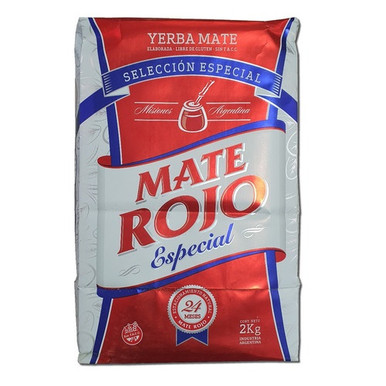
Mate Rojo Selección Especial
Yerba Mate Review
7 minutes to read
Share this article
Copy link to clipboard
If you make a purchase through links in this article, I get a small commission at no cost to you. Learn more
A continuation of an already amazing Mate Rojo Tradicional, this special selection yerba mate manages to build on top of all the good things from traditional version while improving some of its small drawbacks and adding new twists here and there. Mate Rojo Selección Especial is not a huge improvement over its traditional sister yerba, but it never could be, granted how fantastic was the original version. Think of it more like a great alternative — very similar and recognizable as Mate Rojo, but still different and unique in its own way, proving one more time the beauty of long aging and how gourmet yerba mate can be. A must-have for all serious materos, especially the ones who already enjoyed Mate Rojo Tradicional, and a reason to be proud for Argentine yerba mate industry.
Use code MateExperience10 for 10% off the whole order!
First look
Nose
The aroma of Mate Rojo Selección Especial is absolutely mesmerizing, which should not come as a surprise if you already had a traditional version of this yerba mate.
This time it’s aged for a whopping 24 months, creating an extremely fragrant and rich nose, full of intricate and delicious notes.
Mate Rojo Selección Especial smells a little sweeter than woodsy, with notes of caramel, vanilla, honey, dry fruits and maple syrup coming out slightly more forwardly, while earthy, cedary and tobacco notes take a back seat and are not as pronounced as in the Mate Rojo Tradicional.
Aging also seem to almost eliminate any bitter vegetative and grassy smells from this yerba mate, allowing those candy-like sweet notes to shine brighter and create an absolutely heavenly aroma.
Cut
After drinking through almost a full bag of Mate Rojo Selección Especial and shaking it vigorously each time to distribute it evenly, I can state that the cut of this yerba mate is quite different to that of a traditional version.
Mate Rojo Tradicional was a very exemplary con palo cut with a nice balance between leaves, stems and powder, quite dusty, but this special selection is on a dustier side — at times it reminds me of Uruguayan P.U.1 cut more than an Argentine con palo cut.
It still contains a healthy amount of stems, but even those stems are quite fine without any large pieces that stand out.
Leaves, on the other hand, are varied in size, ranging from small, almost powder-sized particles to larger and coarser chunks.
My anecdotal theory is that due to a longer aging leaves and stems tend to naturally break down into smaller pieces creating this dustier and fluffier than regular con palo cut.
The color of Mate Rojo Selección Especial is pretty uniform with some rare inclusions of toasted brown leaves but without any lifeless looking pale bits, and overall is pleasant to look at — most likely a standard drying method was used, and extensive aging rounded out any unevenness in the color of the cut of this yerba mate.
Preparation
Dustier cut may present some challenges to a beginner matero while preparing Mate Rojo Selección Especial traditionally.
It is a good idea to use a
spoon bombilla for this mate, and to make sure that it won’t cause any clogging issues while drinking it, do yourself a favor and mold the proper mountain after doing a first pour of room temperature water.
I find that this yerba mate soaks that first pour completely which makes it very malleable, allowing you to create a beautiful and sturdy mountain that will not fall off even after several refills.
Keep in mind that it is still a con palo yerba mate, so you can rely on the stems to aid in filtration, once you properly shake the gourd upside down.
As with traditional version of Mate Rojo, this yerba mate does not play well with colder water — anything below
70° C/160° Fwill make this mate weaker, bleaker and simpler in taste, which does not do a justice to such an exquisite special selection yerba.
Unlike Mate Rojo Tradicional, this yerba mate is not ruined by water that is on a hotter side.
I still find the taste of Mate Rojo Selección Especial balanced and delicious with
80° C-85° C/175° F-185° Fwater, although it changes its effect and lowers its durability.
Therefore, my preferred water temperature for this yerba mate is the same as for traditional one —
70° Cto75° C/160° Fto165° Fwill yield in a mate that has both the best flavors and longest durability.
First sips of Mate Rojo Selección Especial, just as the traditional version, may overpower even an experienced mate aficionado.
I get significant bitterness and earthiness, as well as some salty notes in first few sips of this mate.
As I go on with next few refills, my palate starts to get accustomed to the flavor overload and I start to dissect what I’m tasting.
The notes of oversteeped black tea are replaced with smoother, milkier, maltier notes — unlike the nose of Mate Rojo Selección Especial, I still don’t taste almost any sweet flavors.
Although smoother, this mate still tastes “dark”, as I get notes of rye bread, wood, leather and chocolate.
The more refills this mate takes, the more it evolves into something sweeter.
This again comes to no surprise, as Mate Rojo Tradicional behaved in a very similar way.
Although this time it is not just a fruity sweetness, but more like a pastry or some other baked treat.
After about 10 refills, the dominant notes are chocolate milk, cookie dough and churros.
I also get notes of cornflakes, sweet fruit bread, panettone and something that reminds me of a croissant filled with fruit jelly.
Two years of aging and dusty cut truly create a very interesting combination of flavors with a solid medium body.
Finish
If you missed those abundant tart fruity notes that are found in the taste of Mate Rojo Tradicional, but not much in this special selection, don’t worry — they reemerge in the aftertaste of this mate.
The finish of Mate Rojo Selección Especial is pleasantly bold and astringent.
Notes of dry fruits, raisins, baked apples are not hiding anymore, and leading all of them is the strong and bitter-sweet flavor of cherry pit.
It is not the most drinkable mate — the aftertaste packs enough flavors to ponder and explore after each sip.
The similarities between Mate Rojo Selección Especial and traditional version can be found here as well, as both of these mates have a distinctive and long-lasting finish.
However, it’s remarkable to me how they still are unique and to some extent even opposite to each other — more prominent buttery doughy sweet notes in the taste turn into fruity notes in the aftertaste of this special selection mate and vice versa in a traditional Mate Rojo.
Install our free web app!
It is instant and won't take up space on your device. Keep reading Matexperience anytime, anywhere — even offline.
Durability
Unless you prepare Mate Rojo Selección Especial with water that is hotter than
80° C/175° F, you should expect this mate to last for quite some time — on average, I was able to get from 28 to 30 refills, which makes it a solid long mate.
It’s definitely an improvement from Mate Rojo Tradicional, which despite still being considered by me as a long mate, was not nearly as stable and constant as this special selection version.
At hotter temperatures, Mate Rojo Selección Especial was much less durable, just like the traditional Mate Rojo, but still had relatively more refills, about 20.
As I mentioned earlier, this mate exhibited an interesting evolution of taste throughout the duration of drinking, and those flavor shifts were very smooth and fluid, making it very engaging and fascinating.
Transition to lavado was also gradual, and I enjoyed sipping on Mate Rojo Selección Especial for few more refills even after it became almost completely washed out.
The last thing you want while drinking mate is to constantly re-heat your water or add more ice to it.
No matter if it's hot mate or cold tereré,
use a
vacuum bottle
or a very popular in South America
mate thermos
with spout.
Effect
Even when it comes to effect, Mate Rojo Selección Especial invites comparison with its traditional version.
Mate Rojo Tradicional was one of those rarer relaxing mates, and this special selection is not an exclusion — the relaxation this mate provides is more calming and stabilizing than sedative, and I found that it was as effective at calming my body as it was at soothing my mind.
Sure, it won’t magically eliminate all grogginess if you haven’t had enough sleep, but don’t be afraid to sip on Mate Rojo Selección Especial in the morning, especially ahead of a big and stressful day.
One more note, again on the temperature — if you still want to drink this mate with water that is hotter than
80° C/175° F, be aware that it might lose those relaxing properties.
I personally did not experience any calming effects when I brewed Mate Rojo Selección Especial with such hot water.
It still did not display energizing effect, as I found it to be pretty neutral rather than relaxing at this temperature.
* * *
What are your thoughts on Mate Rojo Selección Especial? Comment below!
Join the free email newsletter!
Get access to new content as soon as it is published and receive exclusive offers, deals and discounts on yerba mate and related products! You can unsubscribe anytime.
Con palo
With stems in Spanish.
Con palo is a type of yerba mate cut which is characterized by presence of stems, or palos in Spanish.
Usually mate brewed with con paloyerba mate is more light and sweet than mate prepared from sin palo cut.
Very popular in Argentina and Paraguay.
In Argentina, according to point 2.1 of the article 1194 of Argentine Food Code, con paloyerba mate should contain no less than 65% of dried leaves, coarsely ground or pulverized, and no more than 35% of coarsely or finely ground stems and sticks.
A vessel used for drinking mate traditionally.
Usually it is made from a real dried calabash gourd, or calabaza in Spanish, hence the name.
Today the term gourd is used not only to describe a calabash vessel, but any other cup from which mate is being drank (wooden, metal, ceramic, etc.).
Spanish adjective which means washed.
Lavado is used as a term to point out that all the flavors “washed away” from mate and it becomes tasteless at the end of the drinking session.
The more refills yerba mate can take before becoming lavado, the longer durability it has.
Pronounced [MAH-teh].
Traditional South American caffeine-rich infused drink, very popular in Argentina, Paraguay, Uruguay and Southern Brazil (the term chimarrão is used there more often).
It is prepared by steeping dried leaves of yerba mate in the gourd.
Sometimes the gourd itself is referred to as mate.
When mate is prepared traditionally, a mountain of yerba is yerba that is located inside the gourd in form of slope, that is exposed to hot water while drinking.
Proper mountain of yerba will be always half-dry and half-wet, which results in more balanced and long mate.
On the opposite side of mountain is the water hole.
Short for Padrón Uruguayo 1, or Uruguayan Standard 1 — one of three common standards of yerba mate cut in Uruguay.
Yerba mate that is marked as P.U.1 consists of not less than 90% of pulverized dried leaves, and not more than 10% of finely ground dried stems.
P.U.1 is the finest cut out of three.
Most popular type of cut in Uruguay.
Pronounced [YER-bah MAH-teh] (or [SHER-bah MAH-teh] in Rioplatense Spanish).
Also known as Ilex paraguariensis, a holly plant natively grown in South America, particularly in Northern Argentina, Paraguay and Southern Brazil (the term erva mate is used there more often).
Yerba mate is used to make a beverage known as mate in Spanish, or chimarrão in Portuguese.
Often, the term yerba mate is used to describe not only a plant, but also a final product of grinding, drying and aging the plant.