These cookies are used to provide you with a more personalized experience on our website and to remember
choices you make when you use our website.
For example, we may use functionality cookies to enable commenting functionality.
These cookies are used to collect information to analyze the traffic to our website and how visitors are
using our website.
For example, these cookies may track things such as how long you spend on the website or the pages you visit
which helps us to understand how we can improve our website site for you.
The information collected through these statistics and performance cookies do not identify any individual
visitor.
Read more about exact cookies we use in our Privacy Policy
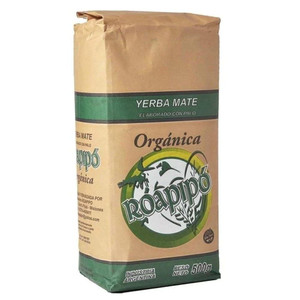
Roapipó Tradicional
Yerba Mate Review
7 minutes to read
Share this article
Copy link to clipboard
If you make a purchase through links in this article, I get a small commission at no cost to you. Learn more
Drinking this mate made me feel like I’m trying to have a conversation with a really shy person. No matter how I approached Roapipó Tradicional, it always seemed to me that it was withholding something from me, that it should be much more bright and interesting than it is. I tried different temperatures of water, I drank this mate at different times of day, I even did set it aside for a few months, hoping that it will speak to me differently as the time passed. And even though I wasn’t able to get I what I wanted or expected from this mate, I can’t shake the feeling that something is left unsaid, and that there is still some sense of mystery and understatement that is coming from Roapipó Tradicional. Even though it’s hard for me to recommend this yerba mate, I wonder if you will feel the same after trying it.
Use code MateExperience10 for 10% off the whole order!
First look
Nose
When I opened a bag of Roapipó Tradicional, I expected to smell notes that are usually found in organic yerbas, such as compost, soil and decomposing leaves.
However, the nose of this yerba mate turned out to be very subtle and shy.
I had to take a really deep whiffs to get any aroma of Roapipó Tradicional.
All I got was hints of sawdust and some cardboard notes, that probably came from the paper bag that this yerba mate was packed in.
The lack of aroma really surprised me and made me cautious about the taste of Roapipó Tradicional.
Cut
Looking at the cut of this yerba mate, I started to understand the absence of aroma of Roapipó Tradicional.
It is very stem-forward, much more than the average Argentinecon palo yerba mate.
In fact, that might be one of the most, if not the most “stemmy” yerba mate I’ve ever had!
Unlike leaves, stems hold less flavor and aroma, and are more woodsy, which might be one of the reasons for the very faint nose of Roapipó Tradicional.
Not only the composition, but the grind and the color of the cut of this yerba mate is very uneven.
Both leaves and stems range from huge chunks and logs to a very fine pieces and splinters.
Color of leaves spans from pale aged pieces to darker olive green and even toasty brown ones.
All together it gives Roapipó Tradicional a very rustic and wild look.
Preparation
The abundance of stems and the size of some palos and leaves makes it trivial to prepare Roapipó Tradicional.
There is no way you’re going to clog your bombilla, no matter the filtration system or whether you’re going to build and maintain the mountain of yerba, as long as you shake your gourd upside down to make sure that all the large stems and leaves are ending up at the bottom of the gourd where your bombilla filter rests.
When it comes to the temperature of water, Roapipó Tradicional is a fairly forgiving yerba mate.
In my experience, any water from
70° Cto85° C/160° Fto185° Fis going to be just fine for this mate.
I still slightly prefer the standard mate temperature, which is
70° C-75° C/160° F-165° F, because in my experience it allows you to squeeze a few more flavorful refills from Roapipó Tradicional.
Colder water,
60° Cto65° C/140° Fto150° F, I find to be too weak to extract all the flavors that this mate has to offer, and makes Roapipó Tradicional too bleak and short.
After an almost non-existent nose, I was afraid that taste of this mate will also be weak, mild and flavorless.
Luckily, when I had a first sip of Roapipó Tradicional I got what I wanted from this organic mate — earthy, robust and “rainforesty” notes.
The taste and the body of this mate is still light, which is to be expected from such large quantities of stems, and the flavors themselves are pretty straightforward and simple, but they are clear and distinguishable.
Roapipó Tradicional is not sweet, nor it is bitter or strong.
I get some smokiness, which is not overpowering yet noticeable.
Earthy notes remind me more of a forest floor rather than compost.
I also get woodsy notes, but not a sawdust, like in the nose of this yerba mate, but more like a damp bark of the tree.
Not the groomed garden tree from your backyard, but a wild forest tree, covered in moss and lichen.
It may not sound like something you wanna drink, but this combination of flavors really works for mate and in my opinion can be a great introduction to more complex yerbas that may be too overwhelming with their abundance of seemingly non-edible flavors for a novice matero.
With Roapipó Tradicional those earthy mossy damp notes are simple and “neutered” in a good way, and with a little open mindedness are an interesting step away from more sweet and delicious dry fruity notes that are present in more beginner-friendly yerbas, such as Playadito Con Palo.
Finish
With such a subtle nose and light simple taste, it was hard to expect a long and flavorful aftertaste from this mate.
And it is quite watery, bleak and non-existant.
On one hand, it makes Roapipó Tradicional feel too simple and not exciting, but on the other hand it is a very drinkable mate, that you can sip non-stop if that is what you want and not be afraid that you will exhaust your taste buds.
Install our free web app!
It is instant and won't take up space on your device. Keep reading Matexperience anytime, anywhere — even offline.
Durability
Even though water that is colder than
70° C/160° Fwill give you a very short mate from Roapipó Tradicional, don’t expect a long durability from it even with appropriate temperature.
It’s hard for me to even put this mate into a moderate durability category — every time I was drinking Roapipó Tradicional at
70° Cto75° C/160° Fto165° F, I got anywhere from 14 to 16 refills from this mate, which is right around that 15 refill mark that I consider a stepping stone from short to moderate durability.
Add to this the overall simplicity and mildness of the flavors, which makes it quite hard to determine when Roapipó Tradicional actually becomes lavado, and you have a mate that at least to me feels more like short than moderate.
On the plus side, the shortness combined with drinkability of this mate and almost complete lack of aftertaste that I mentioned earlier, make Roapipó Tradicional a suitable choice when you are in a hurry and only have a small window of time for your mate and don’t want to leave your mate unfinished only to come back to a more stale and less fresh-tasting brew.
The last thing you want while drinking mate is to constantly re-heat your water or add more ice to it.
No matter if it's hot mate or cold tereré,
use a
vacuum bottle
or a very popular in South America
mate thermos
with spout.
Effect
Not always do you need a yerba mate that is packed with energy and wakes you up like a gallon of coffee.
And with me trying to get an adequate amount of sleep each night and building a natural high levels of energy through exercise, I am less and less looking for a mate that is energizing, because it may be too much of a kick for me even though I have a pretty strong caffeine tolerance, and more and more starting to appreciate yerbas with neutral effect, where I still get the mental clarity, improved cognitive functions and overall health benefits without the physical manifestation of high caffeine dosage, which makes me restless and does the opposite effect of being focused and concentrated.
Roapipó Tradicional is a great example of a such mate — while it was neutral in terms of energy effect both in the mornings and in the evenings, the clarity of mind and overall mental stability that it offered to me was really appreciated.
I especially enjoyed sipping on this mate while doing intellectual work, which makes Roapipó Tradicional a great afternoon mate for studying or work that requires lots of brain power.
* * *
What are your thoughts on Roapipó Tradicional? Comment below!
Join the free email newsletter!
Get access to new content as soon as it is published and receive exclusive offers, deals and discounts on yerba mate and related products! You can unsubscribe anytime.
Body
Characteristic, used to define the tactile feel of mate in the mouth, similar to other gourmet products, like wine or coffee.
It includes the mouthfeel of the drink, its thickness and weight.
Cut of yerba mate, drying methods and aging all contribute to the body of mate.
Usually, body can be described as light, medium and full — the more thick and dense mate feels in the mouth, the more full body it has.
Special drinking straw with a filtration system in the lower end of it.
Usually made from metal or hollow-stemmed cane.
Bombilla is used for drinking mate traditionally from a gourd.
With stems in Spanish.
Con palo is a type of yerba mate cut which is characterized by presence of stems, or palos in Spanish.
Usually mate brewed with con paloyerba mate is more light and sweet than mate prepared from sin palo cut.
Very popular in Argentina and Paraguay.
In Argentina, according to point 2.1 of the article 1194 of Argentine Food Code, con paloyerba mate should contain no less than 65% of dried leaves, coarsely ground or pulverized, and no more than 35% of coarsely or finely ground stems and sticks.
A vessel used for drinking mate traditionally.
Usually it is made from a real dried calabash gourd, or calabaza in Spanish, hence the name.
Today the term gourd is used not only to describe a calabash vessel, but any other cup from which mate is being drank (wooden, metal, ceramic, etc.).
Spanish adjective which means washed.
Lavado is used as a term to point out that all the flavors “washed away” from mate and it becomes tasteless at the end of the drinking session.
The more refills yerba mate can take before becoming lavado, the longer durability it has.
Pronounced [MAH-teh].
Traditional South American caffeine-rich infused drink, very popular in Argentina, Paraguay, Uruguay and Southern Brazil (the term chimarrão is used there more often).
It is prepared by steeping dried leaves of yerba mate in the gourd.
Sometimes the gourd itself is referred to as mate.
When mate is prepared traditionally, a mountain of yerba is yerba that is located inside the gourd in form of slope, that is exposed to hot water while drinking.
Proper mountain of yerba will be always half-dry and half-wet, which results in more balanced and long mate.
On the opposite side of mountain is the water hole.
Stems in Spanish.
Palos are one of the components of yerba mate cut and come from ground stems of the plant.
Stems add lightness, woodiness and sweetness to mate. Yerba mate cut that contains stems is called con palo and yerba mate cut that doesn’t contain almost any stems is called sin palo or despalada.
Pronounced [YER-bah MAH-teh] (or [SHER-bah MAH-teh] in Rioplatense Spanish).
Also known as Ilex paraguariensis, a holly plant natively grown in South America, particularly in Northern Argentina, Paraguay and Southern Brazil (the term erva mate is used there more often).
Yerba mate is used to make a beverage known as mate in Spanish, or chimarrão in Portuguese.
Often, the term yerba mate is used to describe not only a plant, but also a final product of grinding, drying and aging the plant.